
// CASK STRENGTH DAILY
From Grain to Glass
How bourbon transforms from raw grain into the whiskey in your glass; follow the whole journey, one real production stage at a time.
Start the journeyPhoto: Daniel Norris / Unsplash; Kentucky Peerless Distilling Co.
Follow the journey as
Bourbon Mash Bill
- Corn; 70%
- Rye; 12%
- Malted Barley; 18%
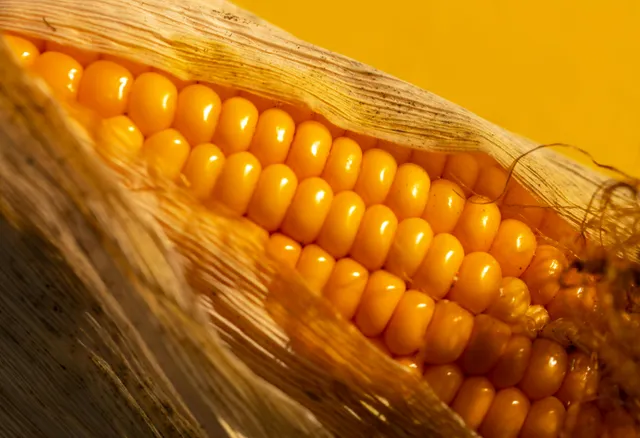
Photo: Mariola Grobelska / Unsplash
Milling
Corn, rye, and malted barley are ground into a coarse flour called grist, exposing the starches inside each grain so they can be converted to fermentable sugar during the cook.
Why it matters: Grain selection sets the raw flavor potential every later stage works with; but it's only the starting point, not a guarantee of a specific taste.
See also:
Sugar Conversion → Fermentable Wort
Cooking
Corn is cooked first at the highest heat, since it's the hardest starch to gelatinize. The mash is then cooled and rye is added at a lower temperature; rye scorches and turns gummy at corn's cook heat; followed by malted barley at a lower temperature still, whose enzymes convert the cooked starches into fermentable sugar.
Why it matters: How carefully each grain is cooked determines how much sugar makes it to fermentation; starch left unconverted is flavor left on the table.
See also: Mash Bill (Grain Bill)
-
Yeast
A proprietary strain (often decades-old and distillery-specific) converts sugar to alcohol and contributes its own fruity/spicy aroma compounds along the way.
-
Sugar
The fermentable sugar produced during cooking is what yeast actually consumes -- no sugar, no alcohol, regardless of how much grain went into the mash.
-
Time & Temp
Fermentation runs three to five days. A hotter, faster fermentation and a cooler, slower one can produce a noticeably different distiller's beer from the same mash bill.
-
Distiller's Beer
The result: a beer-like liquid, roughly 8-10% ABV, ready for the still. This is the last stage before the spirit is actually distilled.
Fermentation
Backset; spent, acidic liquid saved from a previous distillation run; is added to the fresh mash for the sour mash process, dropping the pH to guard against unwanted bacteria before yeast is pitched. Over three to five days the yeast converts sugar to alcohol, producing a beer-like liquid called distiller's beer, around 8-10% ABV.
Why it matters: The yeast strain and fermentation time shape which flavor compounds exist before distillation even begins; distillation can concentrate what's here, but it can't add what isn't.
See also: Sour Mash , Backset , Distiller's Beer
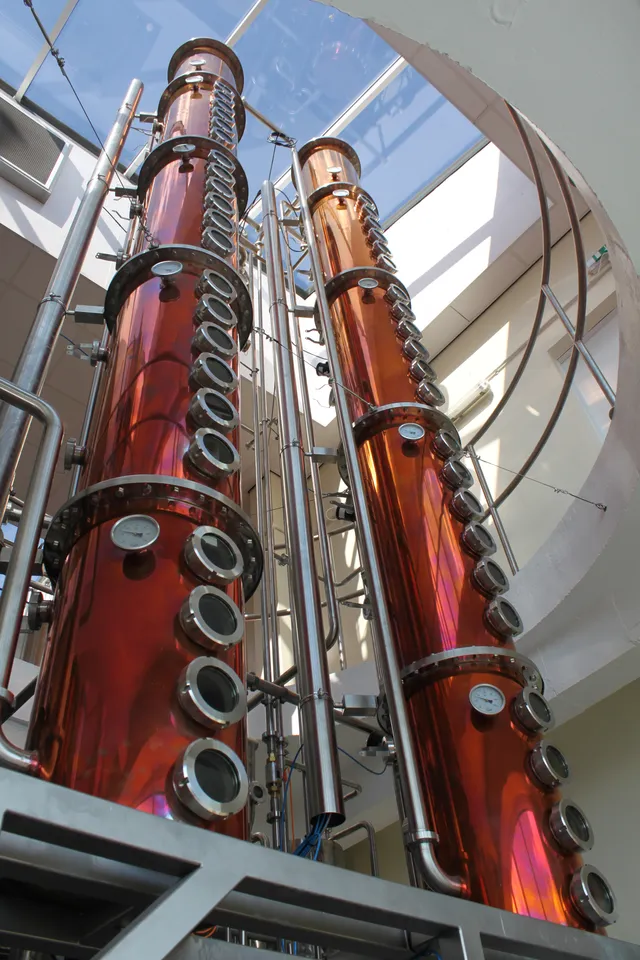
Photo: Mark Longair, CC BY-SA 2.0; via Wikimedia Commons
- Column / Plates
Distiller's beer is fed partway up the column. Each plate is a small boil-condense cycle that strips more water and solids out with every pass upward.
- Vapor Path
Alcohol boils at a lower temperature than water, so it vaporizes first and rises through the column while heavier compounds fall back down.
- Low Wines
What comes off the column still -- a raw spirit around 100-130 proof, not yet what goes in the barrel.
- The Doubler
A second, smaller pot still. Low wines are distilled again here, capped at 160 proof by federal law, concentrating flavor and raising proof.
- New Make
What comes out of the doubler: a clear, unaged spirit -- also called white dog. This is what actually goes into the barrel, not the amber bourbon you'd recognize.
Distillation
Distiller's beer is pumped into a column still; the beer stripper; which strips out most of the water and solids to produce a raw spirit called low wines, roughly 100-130 proof.
Why it matters: The column still's job is separation, not creation; it strips away water and heavier compounds to leave a cleaner, higher-proof spirit carrying forward whatever fermentation produced.
See also: Beer Stripper (Wash Still) , Low Wines
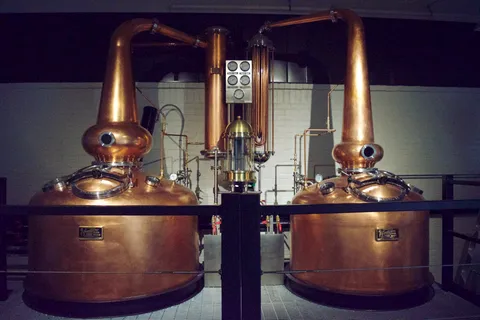
Copper pot stills, similar in form to a doubler; ASW Distillery. Photo: Thechadwix, CC BY-SA 4.0 via Wikimedia Commons
Clear. Unaged. Not yet bourbon.
The Doubler
Low wines pass through a second, smaller pot still; the doubler, or thumper; for a second distillation that concentrates flavor and raises proof, capped at 160 by federal law. The result is new make, or white dog.
Why it matters: The second distillation is where new make gets its real character; the cut points chosen here shape the spirit the barrel will spend years working on.
See also: Doubler / Thumper , New Make / White Dog
Barrel Entry
New make is cut with water to no more than 125 proof; the legal barrel-entry-proof ceiling; then filled into a new, charred oak barrel. The char level, ranging from a light toast to a heavily blistered alligator char, controls how much caramelized wood sugar and tannin the spirit will pull from the barrel.
Why it matters: Barrel-entry proof and char level set the terms of the multi-year exchange between spirit and oak that's about to begin; a lower entry proof and a heavier char both mean more wood interaction ahead.
See also: Barrel Entry Proof (BEP) , Virgin Oak , Char Level (1 through 4) , Alligator Char (#4 Char)
Color develops during maturation
Color comes from the barrel, not from age alone; a darker bourbon isn't necessarily an older one. More on that myth →
Aging
Barrels rest in a rickhouse for years, expanding into and out of the charred wood with each seasonal temperature swing, pulling color, vanilla, caramel, and oak tannin out of the wood. Barrels stored on a rickhouse's hottest floors age faster and can develop into a prized honey barrel.
Why it matters: This is where a clear, unaged spirit becomes bourbon; color, most of the aroma, and a large share of the final flavor all develop here, over years, not days.
See also: Rickhouse (Rackhouse) , Honey Barrel
- Aged Bourbon
- Proofing
- Filtration
- Bottling
- Label
- Glass
Not every bottling follows every step identically; filtration approach and proofing point vary release to release.
Bottling
Once a barrel (or a batch of barrels) is judged ready, the aged whiskey is dumped and proofed down with water to its final bottling strength; a minimum of 80 proof (40% ABV) by federal law, though many releases bottle higher, up to full barrel-proof/cask-strength with no water added at all. Some bottlings are chill-filtered, a cold-filtration step that removes fatty acids and proteins that would otherwise cloud the whiskey at lower temperatures or proof; others are bottled non-chill-filtered, left cloudy-when-cold on purpose to preserve those compounds. The whiskey is then bottled and labeled.
Why it matters: Bottling proof and filtration are two of the last real decisions made about a bourbon before it reaches a shelf; and, along with the barrel it came from, they're a large part of why two bottles of the same brand's whiskey can still taste noticeably different.
See also: Barrel Proof / Cask Strength , Chill Filtration (Cold Chill Filtered) , Non-Chill Filtered (NCF)
// FROM GRAIN TO GLASS
Every Bottle Is a Chain of Decisions
Grain, fermentation, distillation, oak, and time; and countless choices made along the way at every single stage above.
Photo: Luwadlin Bosman / Unsplash
// SYNTHESIS
What Actually Changes the Flavor?
Five variables, working together across every stage above -- not one magic step.
Grain
The mash bill sets the raw material every later stage works with. A higher rye or wheat percentage changes what's available to ferment and distill; but it's an influence on the final character, not a guarantee of one specific flavor.
Fermentation
Yeast strain, fermentation time, and temperature all shape which flavor compounds exist in the distiller's beer before a still ever touches it. Distillation can concentrate what fermentation produced; it can't add what wasn't there.
Distillation
Still design and the cut points chosen at the doubler determine how much of fermentation's character survives into the new make, and how clean or robust that spirit is on entering the barrel.
Barrel
Oak source, char level, and barrel-entry proof all set the terms of the spirit's years-long exchange with the wood; color, vanilla, caramel, and tannin all originate here, not before it.
Maturation
Time and environment; rickhouse floor, warehouse, season; govern how much of that barrel exchange actually happens. More years or a hotter floor isn't automatically "better," just a different, more intense interaction with the wood.
// THE LEGAL FLOOR
What Makes It Bourbon?
Everything above describes how bourbon is typically made in practice. What actually makes it bourbon, legally, is narrower: a Bourbon Whiskey is a mash of at least 51% corn, distilled to no more than 160 proof, entered into new charred oak containers at no more than 125 proof, and bottled at 80 proof or higher, with no added flavoring or coloring. It has to be made in the United States; but, despite a common assumption, not specifically in Kentucky.